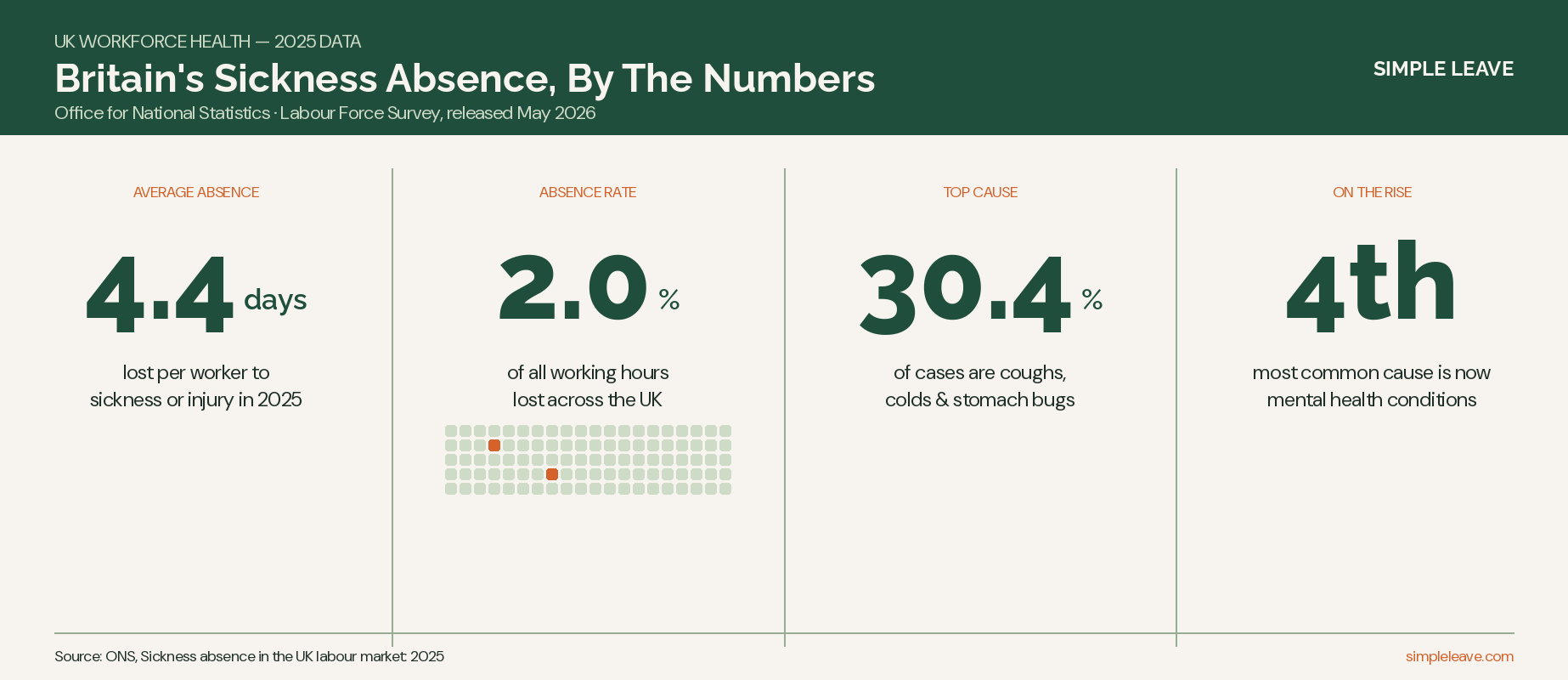
Look at the headline numbers and Britain seems to be the picture of health. UK workers lost an average of 4.4 days each to sickness in 2025. That's a sickness absence rate of just 2.0%, unchanged from the year before.
Compare that to the Continent, where Norwegian workers take an eye-watering 5.7 weeks off a year, Finns take 4.8, and even the notoriously efficient Germans clock up 3.5 weeks. By that measure, Britain looks like the healthiest large economy in Europe. But the comparison flatters us, and 2026 has quietly changed the rules of the game in a way that could make next year's numbers a lot less flattering.
- The UK's 4.4-day sickness figure looks low partly because it excludes people who've left the workforce with long-term illness altogether
- From 6 April 2026, Statutory Sick Pay is paid from day one instead of day four, and now covers an estimated 1.3 million more workers
- Germany, Norway, Belgium, France and Finland are all tightening sick leave rules at the same time Britain has loosened them
- A new Fair Work Agency now has powers to police compliance, giving employers more reason to keep accurate records
- Absence costs are likely to rise through 2026–2027 even if the underlying health of the workforce doesn't change at all
Why the UK number looks so good
Britain's low sickness absence rate isn't really a story about robust health. It's a story about who gets counted. The ONS measure only tracks people who are in work and take time off sick. It says nothing about the much larger group who have left the workforce altogether because of long-term illness, a population that has grown sharply in the UK over the past few years and doesn't appear anywhere in a "days lost per worker" statistic. In other words: Britain doesn't have fewer sick people than Norway or France. It just has more of them sitting outside the labour market entirely, invisible to this particular measure.
Within the numbers ONS does capture, some familiar patterns hold. Minor illnesses (coughs, colds, stomach bugs) remain the single biggest reason given for time off, at 30.4% of cases. But mental health conditions are now the fourth most common cause, and gastrointestinal problems have just overtaken respiratory illness for the first time since 2020. Sickness absence is consistently higher among women, over-65s, part-time workers and public sector staff, and highest of all among process, plant and machine operatives. Geographically, Yorkshire and the Humber has the worst rate in the country at 2.4%; London, with a younger workforce and a heavier concentration of desk-based, high-skill roles, has the best at 1.5%.
Zoom out and the ten-year trend is fairly flat. Absence spiked through the pandemic years, fell back in 2023, and has now held steady at 2.0% for two consecutive years, still 0.1 percentage points above where it stood in 2019.
Europe is tightening. Britain just loosened.
While the UK's numbers have sat still, several European governments have decided their sick leave bills are no longer affordable and are moving to cut them. Germany's chancellor Friedrich Merz has proposed restricting automatic sick notes, arguing the country "can no longer afford the competitive disadvantage caused by prolonged absences from work." Norway is trialling "graded" sick leave, where doctors specify how much of a job someone can still do rather than signing them off entirely, and are financially incentivised to prescribe less time off. Belgium has tightened the exemptions to its existing day-one sick-note rule and shortened the window before employers can treat long-term absence as grounds for termination. France is capping initial sick notes at 31 days from September. Denmark has launched a welfare review explicitly targeting sickness absence. And Finland already has a result to point to: making the first day of sick leave unpaid brought its average down from 5.2 weeks to 4.8 in a single year.
Britain has just done the opposite. From 6 April 2026, the Employment Rights Act 2025 abolished the three-day waiting period for Statutory Sick Pay, so employees are now paid from the very first day they're off. It also scrapped the lower earnings limit, bringing an estimated 1.3 million more workers (disproportionately part-time and lower-paid) into SSP eligibility for the first time.
A new enforcement body, the Fair Work Agency, now has powers to police compliance. It's the same agency that's already requiring employers to keep six years of annual leave records. Where Merz and his counterparts elsewhere are trying to make sick leave harder to access, Westminster has just made it easier, broader, and more expensive from the first hour of absence, and given itself a regulator to check employers are getting it right.
How the UK really compares
Put the raw numbers side by side and the gap is stark. This is average weeks of sick leave taken per worker in 2025: a slightly different basis to the UK's own "days lost" figure above, but it puts the scale of the difference in perspective.
Average weeks of sick leave per worker, 2025, based on national labour-force and social-security data as reported in recent European sick-leave coverage. The UK figure (0.9 weeks ≈ 4.4 days) uses the ONS's narrower Labour Force Survey measure discussed above, so treat the comparison as directional rather than exact.
Even allowing for the fact the UK's own measure and this weeks-based comparison aren't counting exactly the same thing, the order of magnitude is hard to argue with. Norway isn't measuring sick leave six times more generously than the UK. Its workers are just taking a lot more of it, and that gap is exactly what's driving the wave of European reform described above.
The numbers don't quite agree with each other, either
It's worth knowing that "4.4 days" isn't the only figure in circulation for the UK itself. The ONS's Labour Force Survey measure (4.4 days, 2.0%) is drawn from household interviews and only counts hours actually lost relative to contracted hours. The CIPD's separate employer survey puts the average far higher, at 9.4 days per employee, because it's asking businesses directly and captures absence the ONS measure structurally misses. Layer on the fact that the IPPR estimates the hidden cost of workplace sickness (mostly people working while unwell rather than staying home, i.e. presenteeism) has risen by around £30bn since 2018, and the "Britain is fine" story starts to look considerably more complicated than the headline rate suggests.
What to watch for in 2027
Neither the ONS nor anyone else has published a 2027 forecast yet. The next release date for official figures hasn't even been announced. So treat what follows as informed direction of travel, not prediction.
The clearest pressure is mechanical: because SSP is now paid from day one instead of day four, and covers far more workers than before, absence that was previously unpaid and sometimes unrecorded now shows up as a direct cost on the books. That alone is likely to push measured and reported absence, and certainly absence cost, upward through 2026 and into 2027, even if underlying health in the workforce doesn't change at all. Employer bodies are already flagging this as the standout issue for the year ahead, alongside the continued rise of mental health as a driver of long-term absence. With a new enforcement agency watching compliance, there's also more incentive than before for employers to track absence properly rather than let it go unrecorded.
Whether the UK eventually follows Germany, Norway and Belgium toward tighter sick-note rules is an open political question. There's no sign of that appetite in Westminster yet, and the direction of travel this year has been the reverse. But the underlying pressure driving European governments to act (rising costs, an ageing workforce, more long-term conditions) applies here too. It would be surprising if it doesn't surface as a live debate at some point.
What it means for SME owners
For small businesses, the practical takeaway isn't really about Britain vs Europe at all. It's that absence now costs more from the first day than it used to, coverage is broader than it used to be, and there's a regulator with teeth watching how it's administered.
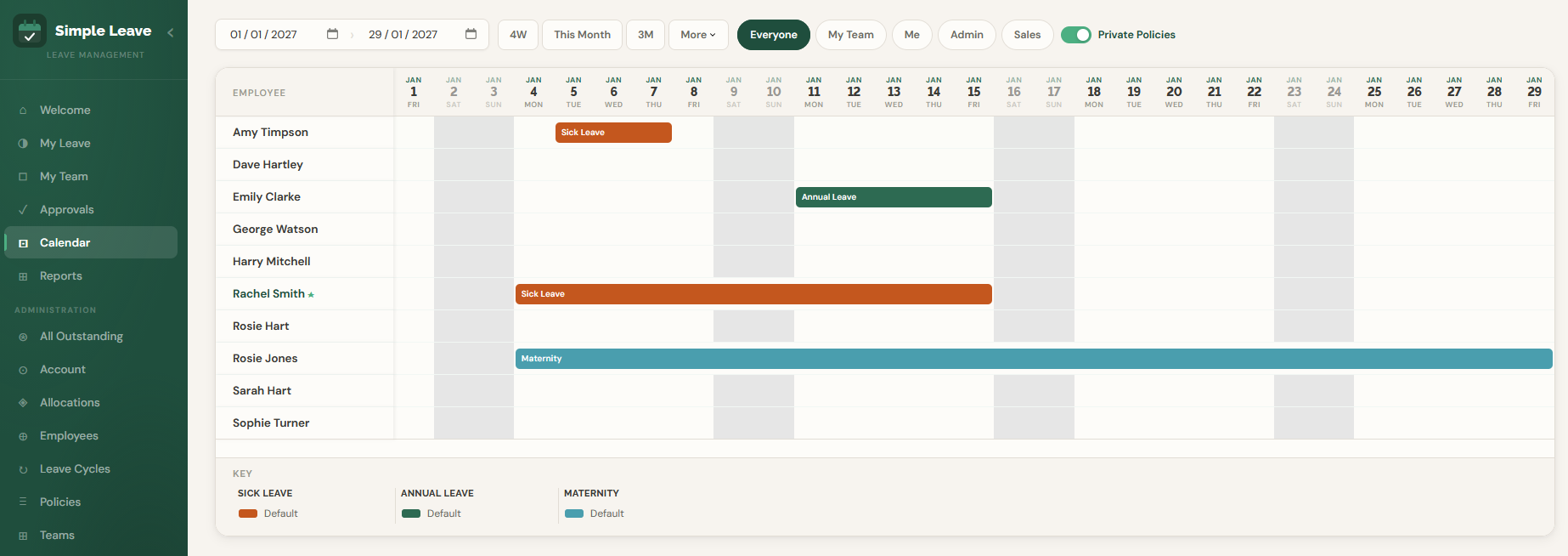
Businesses that can see their absence patterns clearly (which teams, which reasons, which trends are building) are in a far better position to manage the cost and support their people fairly than those relying on a spreadsheet nobody's updated since March. Start with something basic: track sick leave as its own category rather than lumping it in with annual leave, so it shows up separately when you're checking balances or running reports. In Simple Leave, sick leave sits alongside annual leave and every other policy you use, and the same heatmap reports built for spotting annual leave clashes work just as well for spotting when short-term sickness is clustering in a particular team or time of year.
Related questions
Do employers have to pay Statutory Sick Pay from day one now?
Yes. From 6 April 2026, the Employment Rights Act 2025 abolished the three-day waiting period, so SSP is payable from the first day of sickness absence. The lower earnings limit was also removed, bringing an estimated 1.3 million more workers into SSP eligibility for the first time.
What is the Fair Work Agency and does it affect small businesses?
The Fair Work Agency is a new enforcement body launched alongside the Employment Rights Act 2025. It has powers to audit employment practices and require employers to produce documents, and it applies to businesses of every size, not just large employers.
Is UK sickness absence really lower than the rest of Europe?
On the headline ONS figure, yes, but that number only counts people who are in work and take time off sick. It excludes the much larger group who have left the workforce entirely due to long-term illness, which several European countries' broader measures do capture. The UK isn't healthier so much as measuring a narrower slice of the picture.
How can small businesses keep track of sick leave patterns without a spreadsheet?
Track sick leave as its own leave policy rather than folding it into general absence, and look at it over time rather than request by request. Recurring short-term absence on particular days or in particular teams is much easier to spot on a report or calendar view than in a list of individual requests.
The UK isn't in the middle of a sick leave crisis. But 2027 is shaping up to be the year the gap between what the headline numbers say and what's actually happening on the ground gets harder to ignore.
Sources
- Office for National Statistics, Sickness absence in the UK labour market: 2025, released 1 May 2026
- Hans van Leeuwen, Ailing Europe declares war on sick leave, reporting on sick-leave policy in Germany, Norway, Belgium, France, Denmark and Finland
- The Employment Rights Act 2025 (Commencement No. 3 and Transitional Provisions) Regulations 2026, legislation.gov.uk
- Make UK, Statutory Sick Pay: Employment Rights Act Spotlight Series
- CIPD, Health and Wellbeing at Work survey (2025 edition), cited via Sickness Absence Statistics UK