
Most people couldn't tell you off the top of their head how much holiday they're entitled to. The statutory rules aren't complicated, but pro-rata calculations, bank holidays, and mid-year starters catch people out all the time. Here's how it actually works, with numbers.
The quick version
UK workers are entitled to a minimum of 5.6 weeks of paid holiday per year under the Working Time Regulations 1998. For a five-day week, that works out to 28 days.
Everything else — part-time, pro-rata, bank holidays — is a variation of that same starting point.
| Days worked per week | Annual leave entitlement |
|---|---|
| 5 days | 28 days |
| 4 days | 22.4 days |
| 3 days | 16.8 days |
| 2 days | 11.2 days |
| 1 day | 5.6 days |
The statutory cap is 28 days. Working more than 5 days a week doesn't increase statutory entitlement beyond this.
Full-time workers
If someone works five days a week for a full year, the calculation is straightforward.
5 days × 5.6 weeks = 28 days
That's the statutory minimum. Plenty of employers offer more — 25 days plus bank holidays is common — but 28 days is the legal floor.
28 days is also the ceiling for statutory leave. Someone working six days a week would get 6 × 5.6 = 33.6 days mathematically, but statute caps it at 28. You can choose to offer more as a contractual benefit, but you're not required to.
Part-time workers and pro-rata leave
Part-time workers get the same 5.6 weeks — just applied to the days they actually work. The formula is the same: days per week × 5.6.
A few examples:
- 3 days a week: 3 × 5.6 = 16.8 days
- 4 days a week: 4 × 5.6 = 22.4 days
- 2 days a week: 2 × 5.6 = 11.2 days
Fractions are fine to keep. If you round, round up — never down. Rounding down shortchanges the employee, which isn't allowed.
What about bank holidays?
The law sets a minimum of 5.6 weeks. It doesn't say anything specific about bank holidays. That means employers are legally allowed to include bank holidays within the 5.6 weeks, rather than giving them on top.
In practice, two approaches are common:
- Included in entitlement: 28 days total, of which 8 are bank holidays (England and Wales), leaving 20 days to book freely.
- On top of entitlement: 20 days plus 8 bank holidays, giving an effective total of 28 days — or more if the employer offers enhanced leave.
Both are legal. What matters is that the contract is clear about which approach applies.
Part-time workers and bank holiday fairness
This is where it gets slightly more nuanced. If a part-time employee never works on a Monday, they'll never use a bank holiday day — most UK bank holidays fall on Mondays. Deducting bank holidays from their allowance would reduce their usable leave unfairly compared to full-time colleagues.
The fair approach for part-time staff is to give them a pro-rata share of bank holidays, added to their leave pot, rather than automatically deducting specific dates. Many employers handle this through a single total entitlement figure rather than separating bank holidays out.
Mid-year starters
Someone who joins partway through a leave year gets a pro-rated entitlement for the remainder of that year.
The formula: (months remaining in the leave year ÷ 12) × annual entitlement
For example: a full-time employee joins on 1 July, and the leave year runs January to December. That's 6 months remaining.
28 × (6 ÷ 12) = 14 days
Some employers calculate this by days rather than months for more precision, especially for irregular-hours workers. The principle is the same either way: entitlement should reflect the proportion of the year actually worked.
Worked examples
Example 1: Full-time, full year
Sarah works Monday to Friday. Her leave year runs from 1 January to 31 December.
5 days × 5.6 = 28 days
Her employer includes bank holidays in the 28 days. England and Wales has 8 bank holidays, so she has 20 days left to book as she chooses.
Example 2: Part-time, full year
Marcus works Tuesday, Wednesday, and Thursday — 3 days a week.
3 × 5.6 = 16.8 days (rounded up to 17 days)
His employer gives bank holidays on top rather than including them. Marcus's bank holiday entitlement is also pro-rated: 8 bank holidays × (3 ÷ 5) = 4.8 days, rounded up to 5. His total is 17 + 5 = 22 days.
Example 3: Full-time, mid-year starter
Priya joins on 1 October in a January–December leave year. That's 3 months remaining.
28 × (3 ÷ 12) = 7 days for the rest of the year.
Example 4: Part-time, mid-year starter
James joins on 1 July, working 4 days a week. Leave year runs April to March, so 9 months remain.
Full-year entitlement: 4 × 5.6 = 22.4 days
Pro-rated: 22.4 × (9 ÷ 12) = 16.8 days (rounded up to 17 days)
Skip the maths
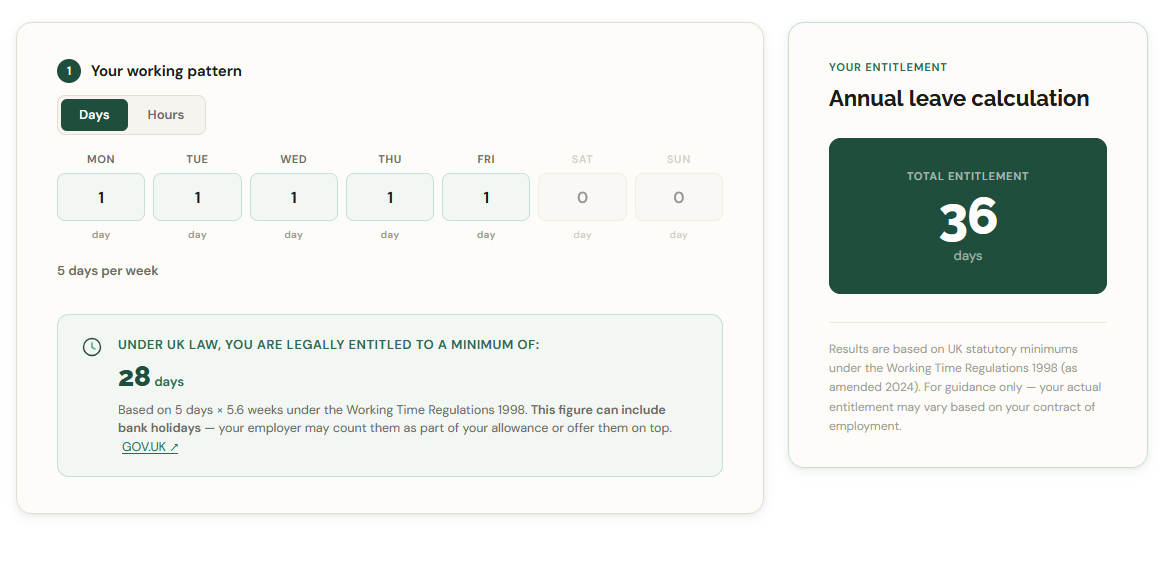
If you'd rather not work through the formula each time, our free UK annual leave calculator does it for you. Enter working days per week, start date, and leave year — it returns the entitlement, pro-rata adjustment, and bank holiday split in seconds.
What counts as the leave year?
The leave year is the 12-month period your employer uses to track holiday. It's often stated in the contract. Common options are January to December, April to March, or the employee's start date anniversary. If there's no contractual leave year, it defaults to 1 October to 30 September under the Working Time Regulations.
Unused statutory leave generally can't be carried over to the next year unless the employee couldn't take it — for example, due to sickness, maternity leave, or a period of shared parental leave.
Keeping track of it all
For a small team, a spreadsheet can work. The problems usually start when you have staff on different patterns, part-year workers, or people returning from long absences with accrued leave to reconcile. At that point, manual tracking gets messy quickly.
Our leave management software was built specifically for this: clear balances for each employee, approvals without the back-and-forth, and the calculations handled automatically regardless of working pattern. Try Simple Leave free for 30 days — no credit card needed.
Frequently asked questions
Does the 28 days include bank holidays?
It can. Employers are allowed to count bank holidays within the statutory 28-day total. Many offer bank holidays on top, but they are not legally required to. Your contract should make this clear.
How do you calculate annual leave for part-time workers?
Multiply days worked per week by 5.6. A 3-day week gives 16.8 days. Round up if needed, never down.
What if I work more than 5 days a week?
The statutory cap is 28 days. Even if 6 × 5.6 = 33.6 days mathematically, you're only entitled to 28 by law. Your employer can choose to offer more.
How is leave calculated for someone who starts mid-year?
Divide months remaining by 12, then multiply by the annual entitlement. Someone with a 28-day entitlement starting on 1 July (6 months remaining in a Jan–Dec year) would get 14 days for that leave year.