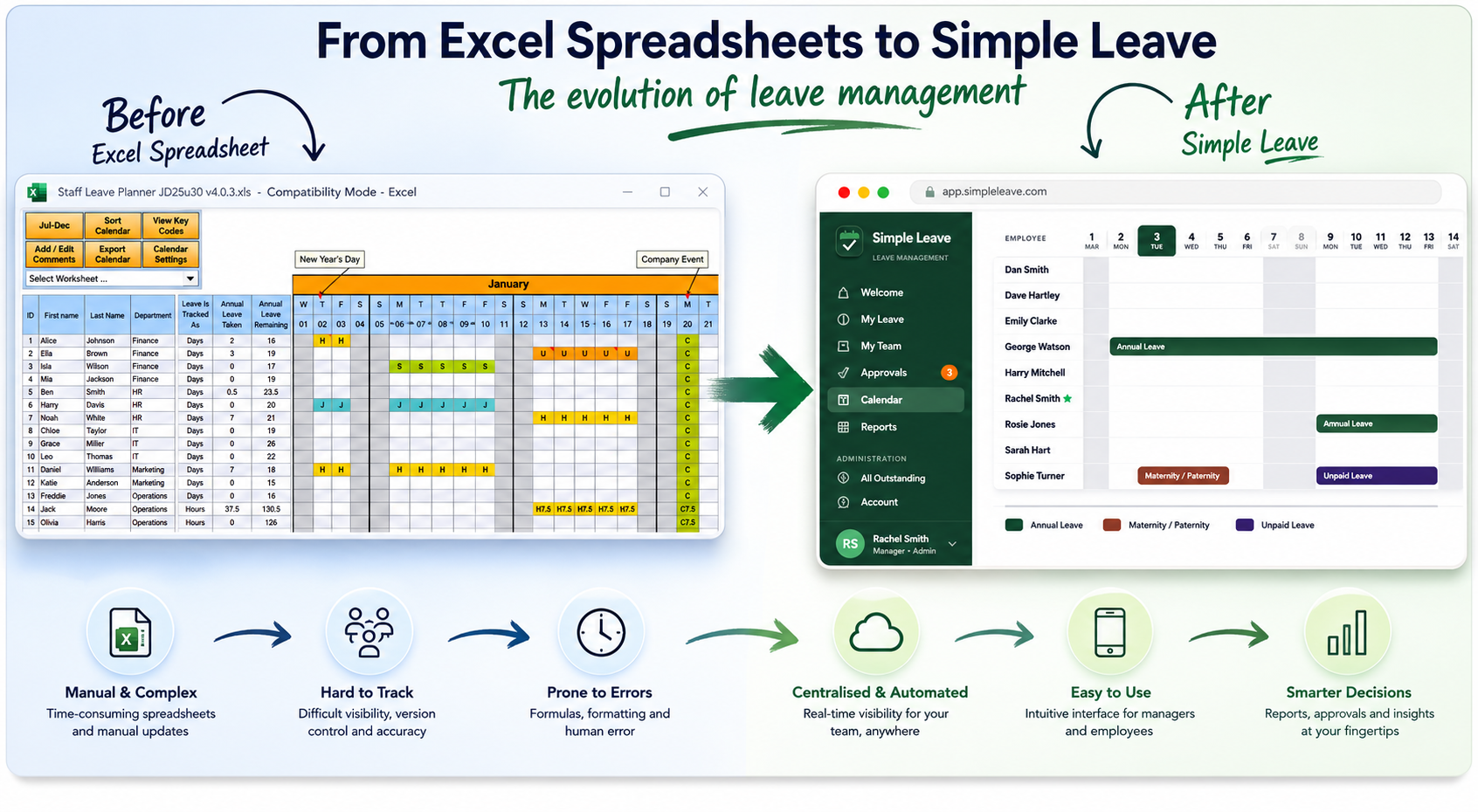
When we launched Simple Leave, one of the first things we argued about internally was the free plan. Not whether to have one, but how much to put in it. I wanted the whole product in there, and that is still how it works: every feature, no time limit, free forever for teams of up to five people.
That decision confuses people, because "free" in leave software usually means a demo with the useful parts taken out. This post is the reasoning behind ours, why the limit is headcount rather than features, and what changes if your team grows past five.
- The free plan is the full product, capped at five active employees, with no time limit and no card.
- Most "free" leave tools hold back something you need, like a second leave type, an approval step, or reports.
- We can give the full product away because the app is lean to run and small teams tend to grow.
- It suits micro-businesses, startups, charities and family firms that need real leave tracking now.
- Past five people it is £0.60 per active employee per month, on the same account, with nothing to rebuild.
Where the free plan comes from
dhxsoft, the company behind Simple Leave, has been making staff leave tools for more than twenty years. It started with Excel. We sold staff holiday planner spreadsheets to small businesses at a low, one-off price, and thousands of them bought one and ran their leave on it for years. That is the business we grew up in.
Those spreadsheets are still on sale, and they still sell every week. They taught us how small businesses actually buy software: the price has to be low enough that the decision is easy, and the tool has to do the real job rather than a demo version of it. Get both right and a small business will happily pay and stick around for years.
They also taught us that a small business values a tool it feels it owns. People kept using our spreadsheets long after a proper system would have saved them hours, because they had bought it outright, it lived on their own machine, and nobody could switch it off or change the terms. That sense of ownership is hard to build on top of a subscription that someone feels they are only renting until the next price rise.
When we built the web app, we wanted to keep that low barrier to entry. A business with four staff should be able to sign up, put their team in, set their holiday allowances, and run the whole thing properly. Not a preview of the whole thing. The whole thing.
Why most "free" leave plans are a trap
If you have shopped around for a free leave tracker, you already know the pattern. The plan is free, and then the part you actually need is not included.
We went through this in detail in our guide to free leave tracking tools, and the same limits came up again and again:
| Common free-plan limit | Why it bites |
|---|---|
| One leave type only | You cannot track sickness separately from holiday, let alone parental leave or TOIL. |
| A three-person cap | Most businesses outgrow it in the first month, then face an upgrade prompt straight away. |
| No approval workflow | Staff can log time off, but no one signs it off. That is a diary, not leave management. |
| Reports behind the paywall | You cannot answer "who is off in August?" without paying, which is half the reason you signed up. |
None of this is dishonest, exactly. The plans really are free. But they are shaped so that the free version does not quite work, and the version that works is the one you pay for. Our free plan has none of these limits. The only thing it will not do is add a sixth active employee.
What our free plan actually includes
The free plan is the same product our paying customers use. For up to five active employees you get:
- Multiple leave types: annual leave, sick leave, maternity and paternity, TOIL, compassionate leave, and any custom types you add.
- Leave requests and a proper approval workflow, routed to the right manager by email.
- A shared team calendar so everyone can see who is off and when.
- Automatic balance tracking, accruals, and pro-rata calculations for part-time staff and mid-year starters.
- Customisable leave policies, working patterns, and UK bank holidays built in.
- Manager and admin reports.
- Email support, the same queue everyone else uses.
There is no "Pro" tier above this that unlocks the good features. The paid plan is the free plan with the headcount limit removed and a bit of onboarding help added. That is the whole difference.
How we can afford to give the full product away
A leave management account does not cost us much to run. The app is a single multi-tenant system, we are not paying a third party per seat and passing that on, and a five-person account uses a rounding error of server capacity.
The £0.60 per active employee per month we charge larger teams is a real number, not a loss-leader we claw back later with add-ons. It covers the cost of running the service and supporting it, with enough margin to keep improving the product. Because that price is low and honest, we do not need the free plan to be a bait-and-switch. We are not trying to frustrate you into upgrading. We are happy for a five-person business to stay on the free plan for a decade.
The model works because small teams grow. Some of the businesses on the free plan today will have fifteen staff in three years, and when they do, moving to the paid plan is a two-minute job rather than a migration. Some of them will tell other small businesses about us. We would rather have a thousand small teams using Simple Leave for free, and a hundred of them growing into paying customers, than put a paywall in front of all eleven hundred and watch most of them leave.
Isn't a free plan just lost revenue?
This is the objection we hear most, usually from other software people rather than customers. The argument is that every free user is someone who might have paid, so a free plan is money left on the table.
We do not think that holds for our market. A business with three or four staff is not weighing up Simple Leave against a £40-a-month competitor. It is weighing up Simple Leave against a spreadsheet, a shared calendar, or a notebook, all of which cost nothing. If we charge that business even a few pounds a month, most of them will stick with the spreadsheet. We would not have converted them. We would just have kept them out.
Charging very small teams also costs money in ways that are easy to forget. Card payments have fixed fees, so a £3 monthly invoice is barely worth processing. Small accounts still raise support tickets, still need the billing system, still generate the odd refund or failed-payment chase. A free plan with a clean headcount limit removes all of that overhead for the accounts where it makes least sense.
The revenue that matters to us comes from businesses that have grown to the point where leave tracking is a real operational need and £0.60 per person is an obvious yes. The free plan is how those businesses find us early, before they are ready to pay, and it is why they are still with us when they are.
Who the free plan is for
The free plan is aimed at the businesses that need leave tracking the most and can justify it the least: the ones with no HR person and no budget line for software.
That is the four-person design studio currently running holiday on a wall calendar. The new startup that has just made its first three hires. The village charity with a handful of staff and a trustee doing the admin in evenings. The family firm where "booking time off" means catching the owner in the kitchen. For all of them, a shared spreadsheet is the status quo, and a spreadsheet does not send an approval to the right person, does not stop two people booking the same week, and does not tell you how much holiday someone has left.
Take a typical case: a five-person agency where the founder approves every holiday request by email and keeps a running total in her head. It works until she is away, or until two designers both assume August is fine, or until someone asks in January how many days they carried over. On the free plan, each of those becomes a non-event. Requests route to whoever is covering, the calendar shows the clash before it is booked, and the carry-over is just a number on a screen. None of that is behind a paywall, because for a team this size there is no paywall.
If that is you, Simple Leave is a free staff holiday planner and time off tracker that behaves like a real system, because it is one. You are not on a trial and you are not on a stripped-back edition.
What happens when you outgrow five people
When you add a sixth active employee, the account moves to the paid plan. Same login, same data, same settings. Nothing to rebuild and nothing to re-import.
Paid pricing is £0.60 per active employee per month. Ten people is £6 a month, twenty is £12, and there is no minimum spend. Larger teams that want to evaluate properly before committing get a 30-day free trial with full access. If you drop back below six active employees later, you drop back to the free plan.
See how our leave management software works
Frequently asked questions
Is the free plan really free forever?
Yes. There is no trial clock and no credit card. The free plan covers up to five active employees with every feature included, and it stays free for as long as your team fits that limit. We have no plans to change it.
What is the catch?
Headcount. The free plan is limited to five active employees. Every other part of the product is included: multiple leave types, approvals, the team calendar, balance tracking, policies, and reports. Nothing is locked behind an upgrade.
What counts as an "active" employee?
An active employee is someone set to active in your account with a live leave allowance. Former or archived employees that you keep for record-keeping do not count towards the five.
Do I need a credit card to start?
No. The free plan only needs an email address. Card details are asked for only if you move to a paid plan after passing five active employees.
If you run a small team, our leave management software is free to use properly, not free to try. Put your five people in, set their allowances, and it will run your leave from day one.